

Royalty Check
A poem for today.

ROYALTY CHECK
So many countries still have their kings
I used to think this a stupid thing.
Not now! ‘cause though I’m a bourgeoisie one,
If I fooled around, I could be one.
You may think me a cad or philistine,
But that’s how England got this queen.
I can’t say if she’s the best or worst one,
But something tells me she’s not the first one.
––––––
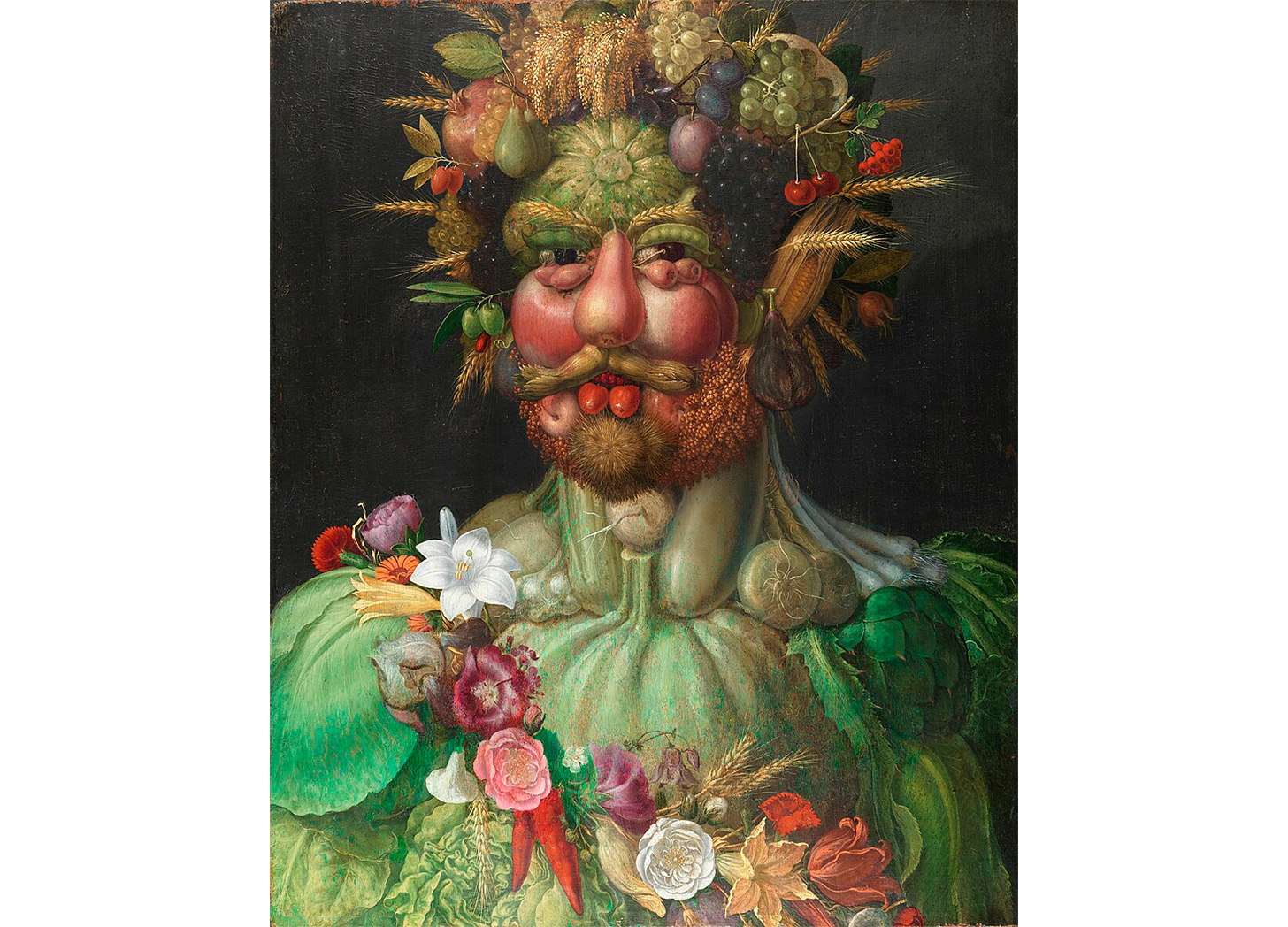
ABOVE: “Vertumnus,” by Giuseppe Arcimboldo, 1591.
Believe it or not, this is a portrait of Holy Roman Emperor Rudolf II, presenting him as the Roman god of metamorphosis, gardens, and seasons.
And you might think Arcimboldo was lampooning the Emperor.
He was not. This painting showers praise on Rudolf for bringing in a Golden Age, one marked by peace, and abundance, and for being a patron of the arts and sciences.
Arcimboldo had a long and successful career. He was multi-faceted. He worked in stained glass and fabrics. He designed costumes and stage settings. He managed festivals and courtly events. He was favored by royal courts throughout his life.
But he is most remembered for his composite head paintings like this one, in which he used fruits, vegetables, flowers, and plants to construct a likeness.
He was admired for these works. To the people of his era, they were packed with symbolism.
An Emperor needed to seem bigger than life. The combination of harmony and abundance presented here, plus the extravagant crown, plus the Emperor’s rule over nature, were pure flattery.
For Arcimboldo, this worked for another reason. Rudolph was a Hapsburg, a successful and ruthless political family based in Vienna, It was a royal dynasty from the 1400s all the way up to the 20th century.
But this meant his face came with the Habsburg Nose, the Habsburg Lip, and the Habsburg Jaw, a set of not so darling features passed down through generations of inbreeding.
If you present Rudolf as fruit and vegetables, you can avoid painting him the way he really looked. It worked. Rudolf liked this painting, which is Arcimboldo’s best known.
If you ever hear someone referring to “mannerist” art, this is an excellent example. It was a remarkable period, 1520-1600, in which artists all over Europe threw away the rulebook.
