

Passing sagacity
A poem for today.

PASSING SAGACITY
On each side of right now lies time.
The Infinites! Future and Past.
Be it chaos, be it sublime,
No one moment is meant to last.
So, let’s raise a toast to right now,
And become savants, wits, and sages.
We’ll get to tomorrow somehow,
And leave yesterday to the ages.
––––––––––
This would have been more fitting on a Friday.
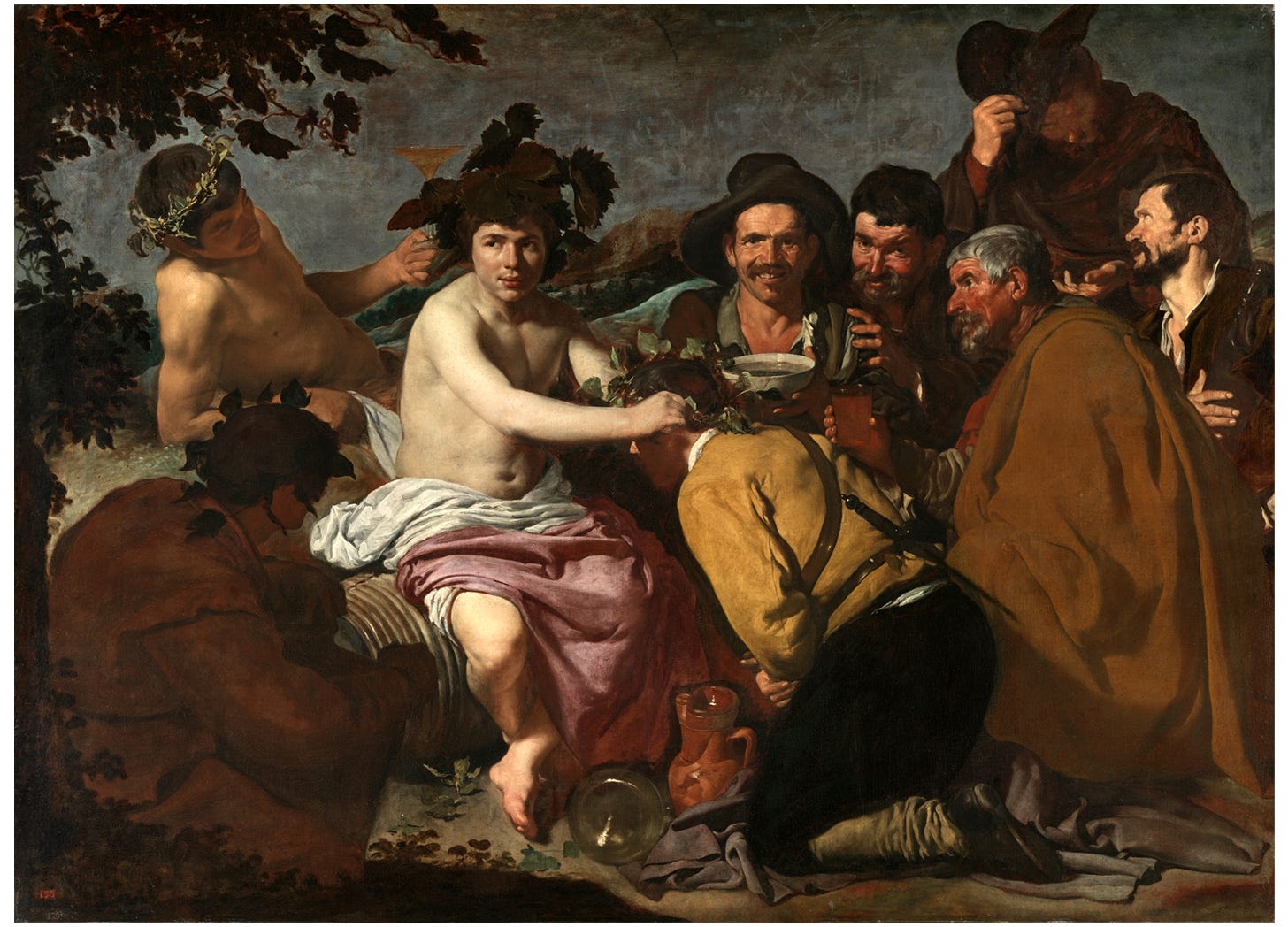
ABOVE: “The Triumph of Bacchus,” Diego Velazquez, 1628.
Commonly known as Los Borrachos (The Drunks), this painting was a departure for Velazquez, the finest painter Spain has produced (my opinion). Before Los Borrachos he painted still-lifes and religious and history paintings.
Lucky for us, the departure became permanent. His best work would follow.
What do we have here? Bacchus, called Dionysus in Greek Mythology, is the Roman god of wine, fertility, and theater. He sits on a wine barrel and gleams in the light. An animal-eared satyr holding what looks like a contemporary martini glass, accompanies behind.
The peasants in the party look directly at us. We are welcomed into the conspiracy, such as it is, while passersby join in. One fellow, who’s dress suggests he’s more than a peasant, is crowned with ivy, as is Bacchus.
There is much about this painting that reverses assumptions. Bacchus, who was commonly portrayed as fat, middle-aged, and dopey, is shown as a young, muscular, self-contained man.
Spanish paintings, unlike Dutch art from the same period, rarely contained drinking scenes. Drinking as a pastime in itself was frowned upon, and to be a called a “borracho” was a corrosive insult. It is said the royal court at the time would invite peasants into theaters and get them drunk as entertainments.
Yet, here, a drinker who is not a peasant is crowned with ivy, like a poet, while the rest laugh back at us (or, perhaps, with us). They’ve become as grand as the god.
But wait, who’s the guy on the left, the one shrouded in shadow? He’s won his ivy crown, but he may be out of the party. A little too much Bacchus and tomorrow arrives early.
The painting demonstrates skill. There are small still-lifes within the painting. In case you might overlook the one at lower middle, the pitcher and glass, Velazquez outlined them in black, like maybe he had a Magic Marker on hand.
The drinkers look modern. Norman Rockwell could have painted the faces.
Stories relate that Velazquez painted this in a tavern. I hope that’s true.
I have a print of this painting in my little room that pretends to be a studio. Bought it at The Prado in Madrid after lingering before this painting for a long while. That was fifty years ago, which is a long time to view a painting of men who have nothing but time.
